Precision Health Guides · Genetics
hello@precisionhealthguides.com
The genetics question game Coming soon

Genes We
Share

Guess it. Talk it out.
Flip it for the science.
55 cards3 games1-6 playersAges 14+
$34.99the deck
See the 3 games
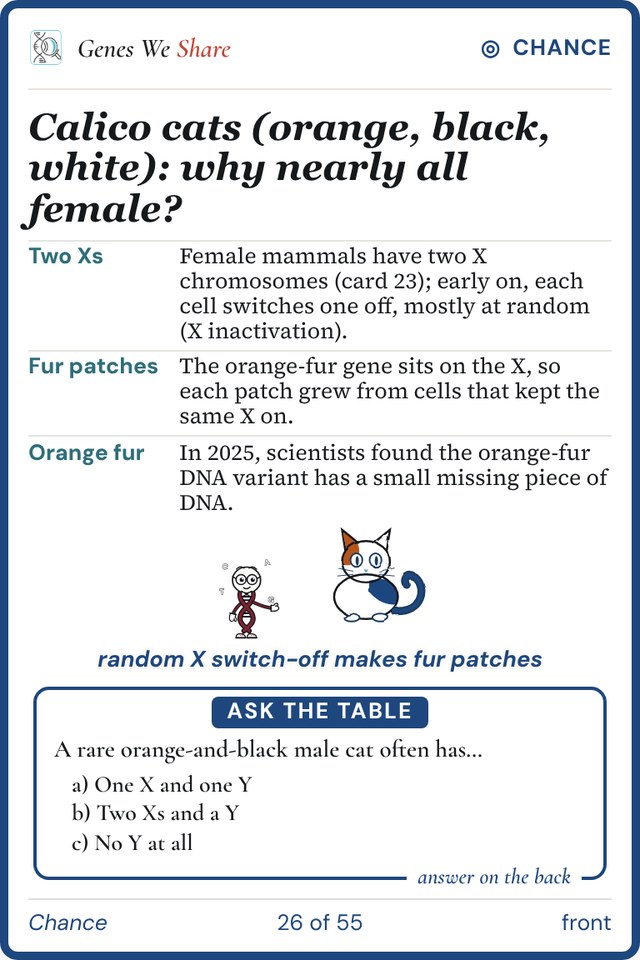
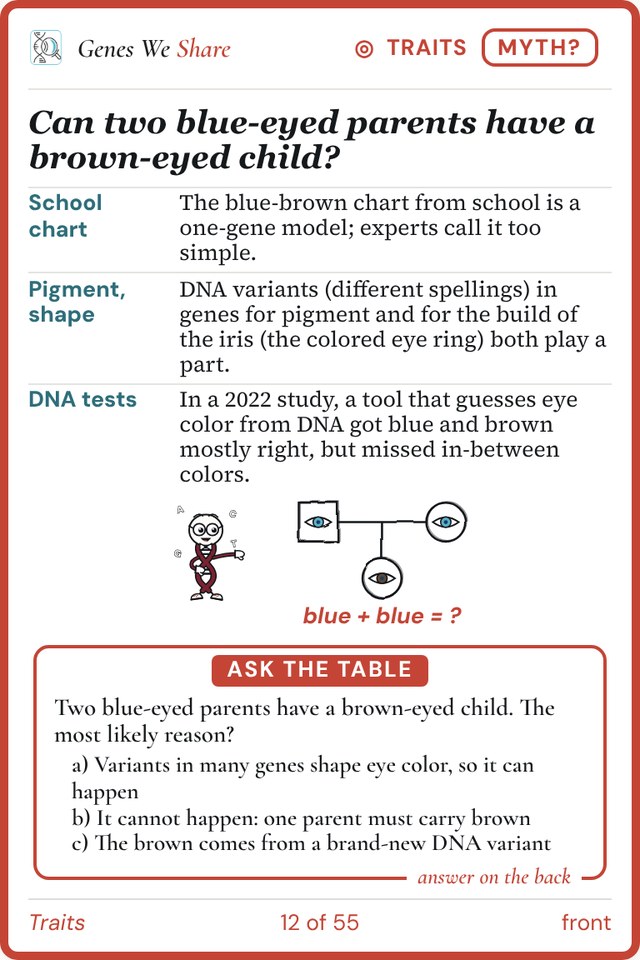
Card 26, front: Calico cats (orange, black, white): why nearly all female?Card 12, front: Can two blue-eyed parents have a brown-eyed child?
3 games in one deck

Each card asks a question the table can argue about, then the back settles it with a published study. No genetics knowledge needed.

Three girls in a row: is a boy due now?
Does your DNA change during your life?
How much of a great-grandparent’s DNA is in you?
1

Quiz game

2-6 players

Read the question and three answers. Everyone holds up 1, 2 or 3 fingers. Explain your answer for 2 points.

2

Lay the tree

1-6 players

A 7-card family-tree puzzle: lay the cards by their corner marks and work out how a trait passed down.

3

Thumbs first

MYTH? cards

Read only the title. Thumbs up or down: true or myth? Then play the card and see who was right.
Every answer backed by published studies
459claims on the cards
~250medical papers
3web pages
On every cardThe study the card describes, by its PubMed number
On the studies pageEvery paper behind every card, with the exact sentence it supports
One tapOpen any paper on PubMed from the studies page
What you learnHow to read a real study and judge it: who was studied, what was measured, how far the result goes
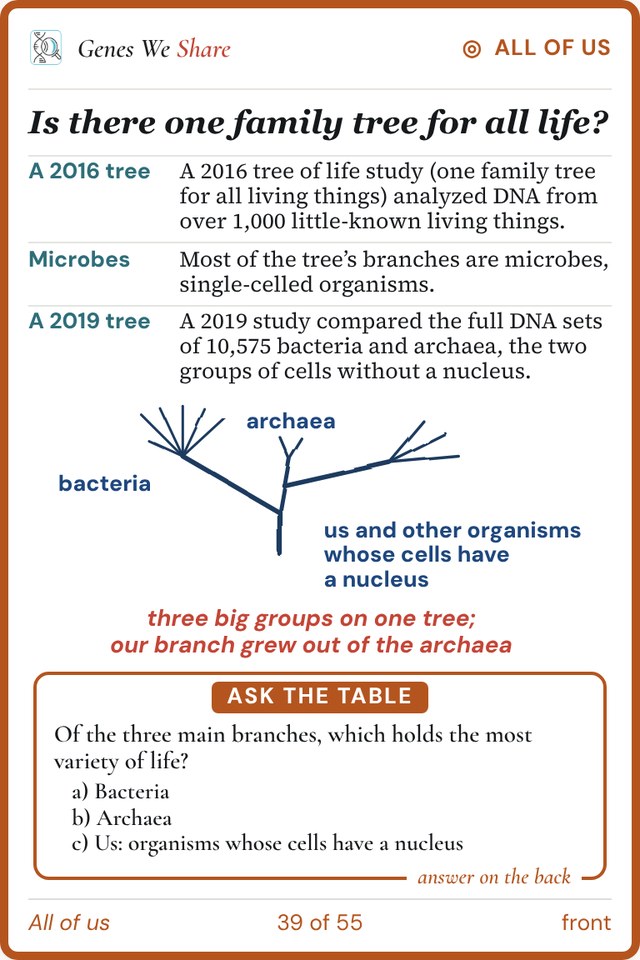
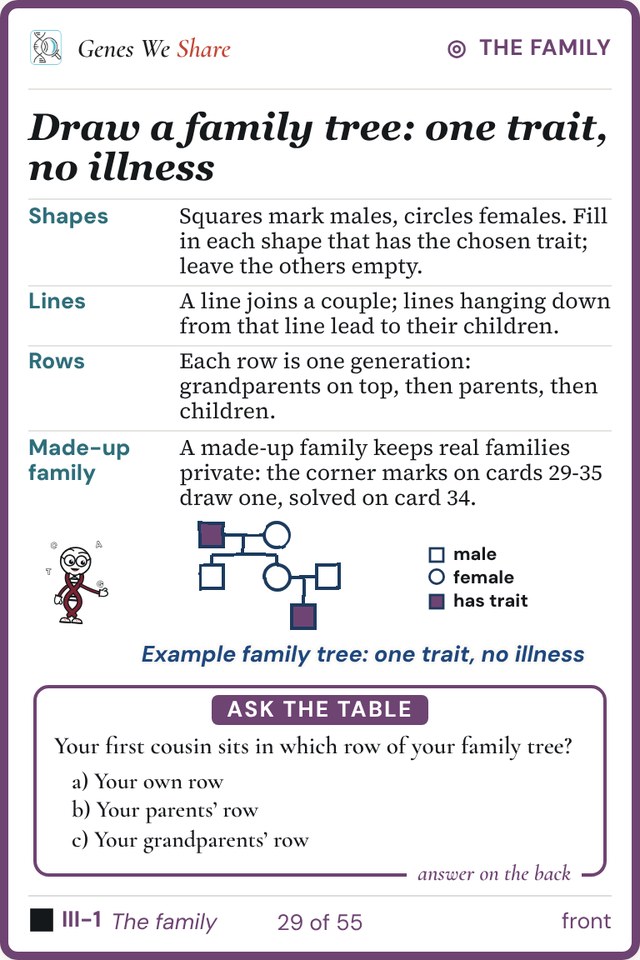
Card 29, front: Draw a family tree: one trait, no illnessCard 39, front: Is there one family tree for all life?
For teachers

Genes We Share · Teacher Edition

$79.99the deck plus the full classroom guide: 6 lessons, NGSS map, answer key and score sheets

The same deck with a Teacher Edition sticker on the box. Its QR code opens the classroom guide.
1LessonsSix lessons covering all seven sections, played in teams
2StandardsNGSS map by card: HS-LS3-1, HS-LS3-2, HS-LS3-3, HS-LS4-1, HS-LS4-4
3Ready to useAnswer key, vocabulary, class score sheet and the family-tree puzzle
4Reading real scienceStudents learn what PubMed is, how to open a paper and read it critically, the way graduate programs run a journal club
▶Free for teachers and students: how to read a studyA short journal-club style video that takes apart one real genetics study
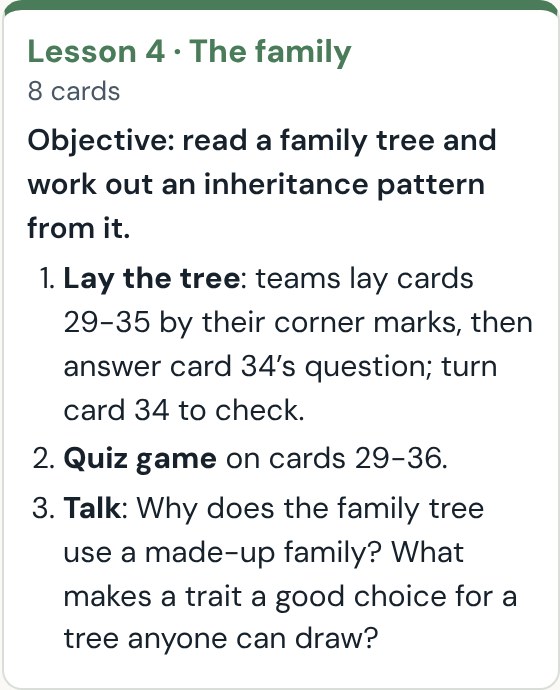
Classroom guide, Lesson 4 · The family

The classroom guide, Lesson 4 · The family. The full guide opens from the sticker’s QR code.

Genetics books
COMING SOON

Lynch syndrome

One patient book that also serves non-genetics clinicians. Lynch syndrome, also called hereditary nonpolyposis colorectal cancer (HNPCC), is the most common inherited cause of colon cancer.

See the sources behind it
1Who it is forAnyone curious about the genetics of Lynch syndrome: people who have it, their families, and anyone wondering about their own risk
2What is insideHow common it is, which genes are involved, what a genetic test result means, and who else in the family should know
3For cliniciansAn FAQ for any clinician whose patients ask them genetics questions
4SourcedEvery statement cites a current clinical guideline or a peer-reviewed study, listed on the sources page
5WhereComing to Amazon
What is coming

These guides are in preparation. Tell me which one you need first: one click, nothing to fill in. The ones asked for most are written first.

Patients and families

Pharmacogenomics

How your DNA variants change the way a medicine works for you, and what a metabolizer result does and does not mean.

I need this one first →
Condition guide

Familial hypercholesterolemia

High cholesterol that runs in families: what the genes do and why first-degree relatives need to know.

I need this one first →
Anyone offered a test

Genetic testing, plainly

What a test can and cannot tell you, how to read a result, and how to decide, including the choice not to test.

I need this one first →
Condition guide

Alzheimer’s disease and genes

The rare families where it is inherited, common risk genes such as APOE, and what testing can and cannot say.

I need this one first →
Condition guide

Hereditary breast cancer

The genes behind hereditary breast and ovarian cancer and what a result means for you and your relatives.

I need this one first →
About

Precision Health Guides

A small publishing house for genetics education. Every title is written by a board-certified clinical molecular geneticist (DABMGG, FACMG) with a PhD in genetics, graduate training in genetic counseling and years of clinical laboratory directorship, for the patients, families and students who can’t get a geneticist in the room. Every statement is traced to a current guideline or peer-reviewed paper, cited where it appears.

Education, not advice. Nothing here is medical advice or a substitute for a genetics consultation; talk to your doctor or a genetics professional about your own situation.